For those that are just beginning to develop a passion for the world of classical music, it can feel overwhelming to explore new composers, time periods, and forms. With over 400 years of repertoire to listen to, it’s not an easy genre to get into. As the great composer and pianist Sergei Rachmaninoff once said:
“Music is enough for a lifetime, but a lifetime is not enough for music.” — Sergei Rachmaninoff
To be exposed to and to listen to various styles of classical music and composers is important for us as musicians and performers. It provides us with the intended character of a piece, the creative norms of the time, and sometimes even history of the composer themself. Exploring music also allows us to gain new insight as to how to interpret and phrase a piece: something that can be hard to determine from a score.
That being said, here are some of my favorite ways to expose yourself to more music:
Youth Orchestras
Most major orchestras around the world will have a youth orchestra, that is, a separate smaller orchestra made up of students. These orchestras usually rehearse throughout the school year (usually August to June) and will host a couple concerts a year.
Youth orchestras provide musicians with a collaborative space to make music, where like-minded individuals are able to come together to produce something larger than sound. While practicing and playing solo repertoire is important for musical development, playing with others in an ensemble provides something solo practice can not.
Playing in ensembles often allows us to focus more on musical interpretation and phrasing, beyond technique and just “playing the notes.” It is one thing to play all the notes correctly; it’s another to make beautiful music. Additionally, ensemble playing provides musicians with the opportunity to develop their listening skills, which can often be used to self-critique and provide honest feedback about one’s own playing.
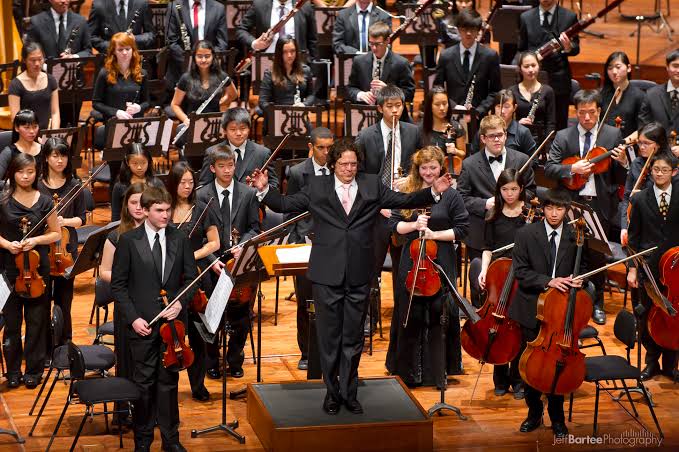
Youth orchestras are also just an amazing way to make friends. For many musicians, practicing can feel isolating and lonely. With youth orchestras, you already have something in common with everyone there, making it ever easier to make new connections.
If you want more information regarding youth orchestras, take a look at the Opportunities page.
Podcasts
One of the best ways to explore music, without actually playing, is through musical podcasts. There are thousands of musical podcasts out there, on platforms like Spotify, Apple Podcasts, and Libsyn. These podcasts cover a variety of topics, including deep dives on music, historical analyses of composers, and even playing tips.
One of my favorite podcasts is Sticky Notes. This podcast presents weekly episodes on different musical pieces, exploring the history and creation behind the piece, melodic and technical analysis, and broader effects of the music.
By listening to this podcast, I’ve discovered so many incredible pieces - both for orchestra and for solo instruments. Many of these pieces are not as well known within the classical canon. As a result, you’ll find some pretty niche composers, as well as not-so-well-known pieces from many famous composers!
Hosted by Joshua Weilerstein, chief conductor of the Aalborg Symphony Orchestra and music director of the Orchestre National de Lille, Sticky Notes has episodes on Beethoven’s string quartets and piano sonatas, Tchaikovsky’s symphonies, and even Rachmaninoff’s piano concertos!
If you’re looking for an episode to get started with, I’d highly recommend the episode on Zemlinsky’s Die Seejungfrau. It’s based off of Hans Christian Anderson’s folk-tale “The Little Mermaid.” Another episode worth checking out is the one on Politics in Classical Music. It’s an incredibly fascinating analysis into how music and politics have affected each other throughout history.
Podcasts to check out


Concerts
If you’re looking to get into the professional music scene, attend a concert! Almost every major city has a symphony orchestra. Simply look up “[your city name]” plus “symphony” or “philharmonic”. Many smaller cities and towns have orchestras as well, though not at the same scale or grandeur.
Don't overlook local universities, conservatories, or community music schools! College music departments frequently host free or low-cost faculty and student recitals. These performances feature high-level repertoire in an intimate setting, making them a fantastic way to discover new pieces without breaking the bank.
If full orchestral concerts feel a bit overwhelming, chamber music (small ensembles like string quartets, woodwind quintets, or piano trios) offers a direct, personal way to experience live music. Look for:
- Local library series: Many public libraries host free weekend concert series.
- Community orchestras & bands: Local non-profit groups often perform seasonal concerts where you can see passionate community musicians in action.
- Museum pop-ups: Art museums frequently partner with local musicians for acoustic gallery performances.
If live in-person concerts aren't accessible near you, the digital world offers endless front-row seats:
- Orchestral Archives: Major organizations (like the Berlin Philharmonic's Digital Concert Hall or the Detroit Symphony's Webcasts) offer streamed performances online.
- Masterclass Clips: Platforms like YouTube feature world-renowned instructors working with advanced students. Watching a masterclass helps you hear a piece in a completely new light while learning how top musicians refine their technique.